
1 · Understand the page
Headline, publisher, author and dates are read from the page’s own metadata.

Ordinis Lens · in Ordinis GO
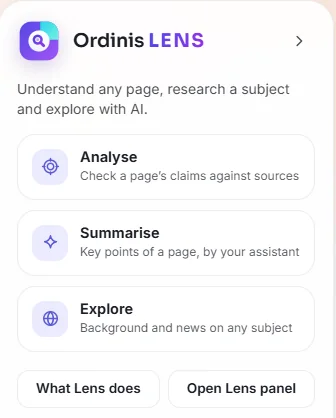
Ordinis Lens is a research companion in your browser’s side panel. It finds the checkable claims on the page, gathers public sources about them, and shows what those sources do and do not support, with exact quotes instead of invented certainty. It can also summarise a page or explore the background and news on any subject.
How it works
Headline, publisher, author and dates are read from the page’s own metadata.
Rules on your computer, not AI, pick out checkable statements and skip questions and opinions.
Short Wikidata and Wikipedia summaries of the people and organisations named, with a note when a name is ambiguous.
Wikipedia excerpts and news coverage for each claim, with publisher, date and link.
An AI step splits each claim into details and says, per detail, what the sources show.
Code, not the model, checks that every quote appears word for word in its source. If not, the label drops to “Not yet verified”.
Honest labels
Labels come from fixed rules over each detail, not from the model’s mood. “Supported” means every detail is supported.
| Label | Meaning |
|---|---|
| Supported | Every detail of the claim is backed by the sources found. |
| Partly supported | Some details are backed; others are missing from the sources. |
| Contradicted | A source says something different, quoted word for word. |
| Sources disagree | The sources found say different things. |
| Sources don’t settle it | A neutral status: the sources found neither back nor contradict the claim. |
| Not yet verified | No usable answer yet, or a quote failed the word-for-word check. |
Lens counts different publishers in the search results. It does not claim they are independent of each other.
Every assessment says it is an AI reading of the sources above, when it was checked and how quotes were verified.
If the service is off, out of credit or unreachable, Lens says so and leaves the sources unweighed.
Privacy
Quiet reads nothing until you ask. Live needs an optional permission that you grant once.
Banking, payment, account, message and health pages, and pages with password or payment fields, are skipped before any text is read. Private and Tor windows are never read.
Search services receive short search terms built on your computer. The AI step receives the claims and the public sources, never the page or its address.
Limits
Platforms
Part of the family
Lens lives in the Ordinis GO side panel, with a toolbar button and a “Check this article” prompt.
While you watch, Kosmo MAX shows cited facts about the cast, director and filming locations, without spoilers if you prefer.
Belgium Pulse follows the same principle: every article lists its sources and says what AI did.
Support us
Ordinis is independent. If an app helps you, you can support its development.
Support usPayments are handled securely by Stripe.
Explore the family

A Chromium-based browser with tracker blocking, Tor windows and Ordinis Lens built in, in six languages.

Your own films and series together with live TV, a TV guide, replay and public broadcasters’ catalogues, in one calm app for the whole household.

News from Belgium with context, in English, French and Dutch, written by AI from cited public sources and published only after automated checks. With What’s On & Expat.